Project overview
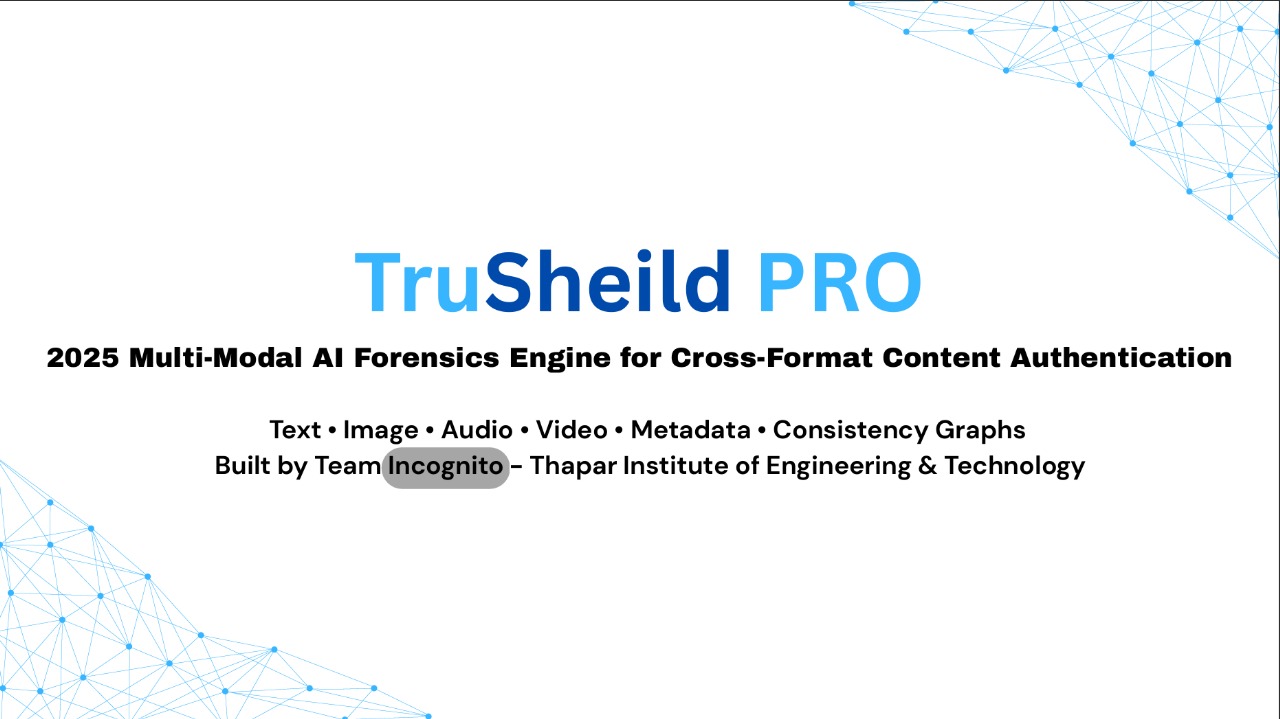
TruSheild PRO is a next-gen AI deepfake forensics engine built to defend creators, brands, and governments against the rise of hyper-realistic synthetic media.
Unlike traditional detectors that rely on single-model heuristics, TruSheild PRO uses a multi-modal transformer pipeline combining visual forgery detection, voice-clone identification, lip-sync analysis, semantic drift tracking, and diffusion fingerprinting.
The system extracts signals from frames, audio, spectrograms, gestures, semantics, and LLM-based linguistic patterns, fuses them with a weighted trust-score engine, and produces a complete forensic report with heatmaps, radar-diagnostics, and explainability.
We built two versions:
Creator Edition — simple interface for influencers, journalists, and everyday users.
National Security Edition — an expanded, high-sensitivity model designed to evolve into a government-grade forensic toolkit.
Our philosophy: “India needs trustworthy media verification. As citizens first, we built TruSheild PRO to contribute to digital safety at scale.”
Jai Hind 🇮🇳
Inspiration
The rise of highly convincing deepfakes—political, celebrity, and misinformation-driven—showed us that current detectors are outdated and unreliable. We wanted to build something actually useful in 2025: a multi-modal, transformer-powered forensic engine that creators, journalists, and authorities can trust. As citizens first, we felt responsible to build a tool that protects digital truth.
What it does
TruShield PRO analyzes a video across five modalities: visual forgery, audio realism, lip-sync, semantic coherence, and speaker identity. It generates heatmaps, spectrograms, cross-consistency checks, and a unified Trust Score (0–100). It outperforms popular online detectors by catching inconsistencies they completely miss.
How we built it
We built a custom pipeline using ViT/ConvNeXt for visual embeddings, Wav2Vec2 + ECAPA-TDNN for spectral audio forensics, GPT-based perplexity for semantic drift, and multi-agent explainers. We fused everything using FAISS-based similarity scoring and built a futuristic React + Vite frontend for real-time reports. The backend is fully Python + PyTorch.
Individual contributions
None
Challenges
Making multiple heavy transformer models run efficiently together
Fixing broken audio pipelines on Windows
Aligning audio–video embeddings for lip-sync checks
Building a clean, futuristic frontend from scratch
Processing diverse video formats reliably
Accomplishments
Built a production-grade deepfake forensic engine in one hackathon
Outperformed existing online detectors
Fully working heatmaps, spectrograms, consistency graphs
Created a unified Trust Score instead of random “real/fake” output
Achieved smooth frontend–backend integration
Learnings
We learned how unreliable traditional deepfake detectors are and how essential multimodal forensics is. We also learned advanced PyTorch model handling, cross-consistency reasoning, and how to build a professional UI that feels like a real product—not a hackathon demo.
Next steps
We are building two versions:
A creator-friendly version for everyday content safety.
A government-grade, hardened forensic version with stronger fingerprinting and legal-grade evidence trails.
Our mission: empower creators—and protect the nation. Jai Hind 🇮🇳