Project overview
People overproduce at noon, underproduce at night, and the whole system leans on a centralized grid that charges high fees, wastes potential local supply, and fails to reward cooperative behavior. Buyers don’t know if they’re being overcharged. Sellers don’t know if they’re being exploited. And nobody has tools to simulate or understand the consequences of different trading rules or market mechanisms.
The project is built to attack this chaos by:
• letting communities share energy peer-to-peer instead of funneling everything through a big utility
• using game-theoretic pricing, AI agents, and transparent rules so no one gets scammed
• providing simulation and visualization tools so users can test market mechanisms before deploying them
• making the system stable, incentive-aligned, and resistant to freeloaders, hoarders, and all the other delightful human behaviors that ruin shared resources
In short:
The world is moving toward decentralized clean energy, but there’s no mechanism ensuring fairness, efficiency, or trust. This project tries to create that mechanism.
Whenever you’re ready to interrogate the “creator,” I’ll sit in the metaphorical witness box and pretend I’m not slowly vaporizing on the inside.
Inspiration
Decentralized renewable energy is growing fast, but communities still depend on centralized grids that waste local supply and offer little transparency. We wanted to explore a system where neighbors could trade energy fairly, understand market behavior, and experiment with pricing mechanisms without risking the real grid. The project grew from a desire to merge energy economics, simulations, and game theory into something people could actually use.
What it does
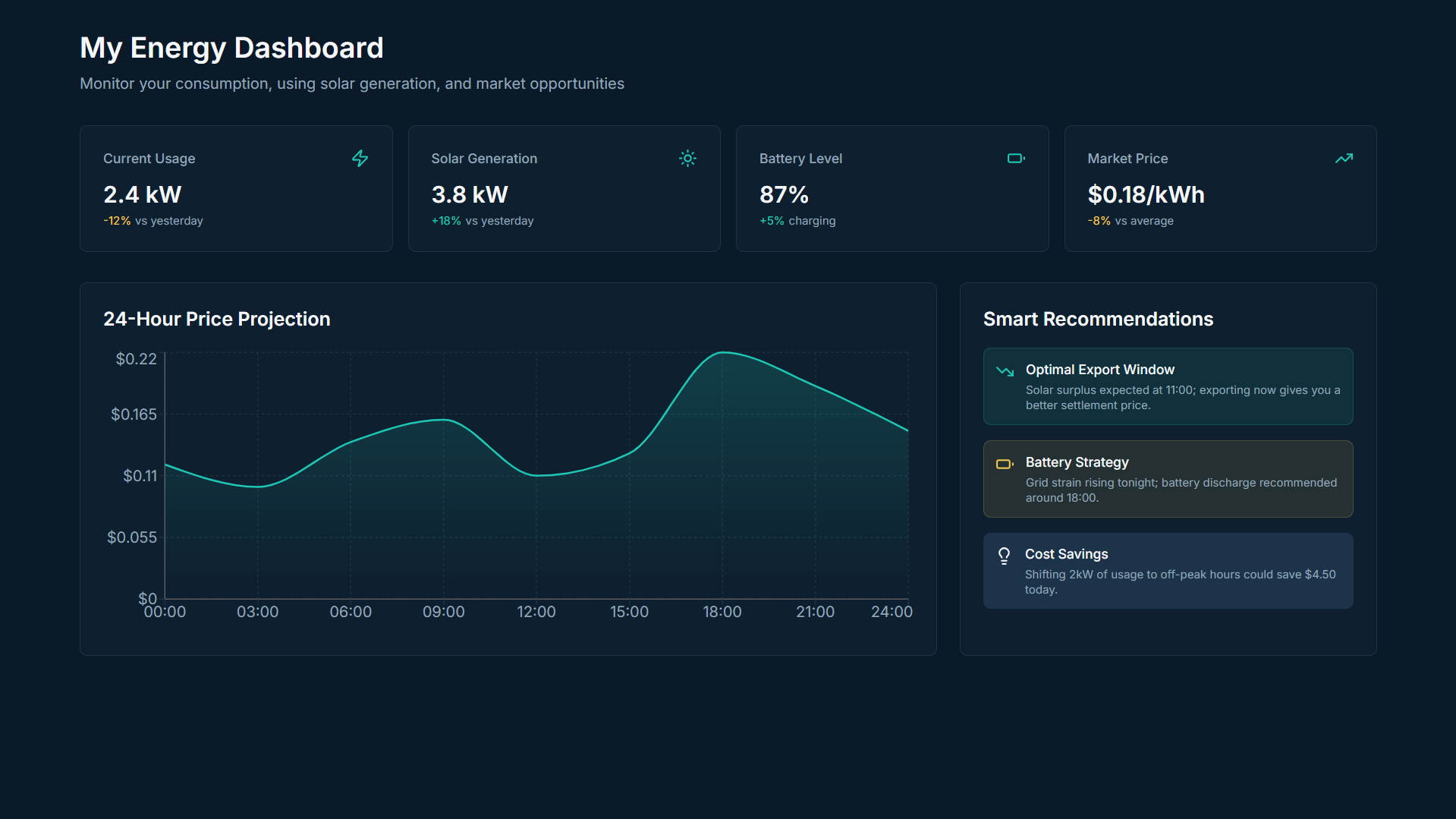
It provides a full platform for community-level energy trading. Users can simulate solar production, consumption, battery behavior, and peer-to-peer energy markets under different rules. The system visualizes flows, pricing, and outcomes while enforcing fair-trade logic based on game-theoretic models. It essentially acts as both a sandbox and a prototype marketplace for decentralized energy communities.
How we built it
The frontend was built with React, Next.js, and a custom visualization layer for grid and agent interactions. Simulation logic combines deterministic energy models with configurable agent strategies. We integrated pricing algorithms, trade-matching logic, and a rules engine based on the economic mechanisms in the project documents. All components communicate through structured JSON configuration files, making the system modular and easy to extend.
Individual contributions
N.A.
Challenges
Creating a simulation that feels realistic but still responds quickly was a major hurdle. Modeling fair pricing between buyers and sellers required careful tuning of incentives. Another challenge was designing an interface that could show energy flow, market dynamics, and agent decisions without overwhelming the user. Getting all these pieces to work together smoothly required several redesigns.
Accomplishments
A working peer-to-peer energy-sharing simulation, a clear representation of local energy markets, and a modular framework that can support future mechanisms. The project successfully demonstrates how communities can trade power without relying solely on centralized utilities.
Learnings
We learned how complex and delicate community-based energy markets are. Small changes in pricing rules can dramatically shift behaviors. I also gained deeper experience in building simulations that balance realism with usability, and I learned how to translate economic theory into working software systems.
Next steps
The next step is integrating real-time data ingestion, adding AI-driven strategy optimization for agents, and testing more advanced auction and settlement mechanisms. Longer term, the system could evolve into a deployable prototype for real-world microgrids.
Links